
answer for
US /ˈænsɚ fər/
UK /ˈɑ:nsə fə/
- other
- Be responsible for and explain one's actions.
C1Moreas well as
US /æz wɛl æz/
UK /æz wel æz/
- Adverb
- Also; in addition to
- Preposition
- In addition to; and also.
A1Moreat home
US /æt hom/
UK /æt həum/
- Phrase
- In one's own residence or country.
- Adjective
- Feeling comfortable and relaxed.
essay
US /ˈɛsˌe, ɛˈse/
UK /'eseɪ/
- Noun (Countable/Uncountable)
- Short piece of written opinion on a subject
- A test of the quality of a metal or ore.
- Verb (Transitive/Intransitive)
- To attempt or try.
- To test or evaluate the quality of something.
B1Moreget at
US /ɡɛt æt/
UK /ɡet æt/
- Phrasal Verb
- To criticize someone, often personally
- To imply something; hint at
A1Morehave to
US /hæv tu/
UK /ˈhæv tə/
- Auxiliary Verb
- Must do
A1Morein general
US /ɪn ˈdʒɛnərəl/
UK /in ˈdʒenərəl/
- Phrase
- Typically; usually; on the whole.
- Not specific or detailed; broadly.
- Adjective
- Not detailed or specific; overall.
C2Moreinstead of
US /ɪnˈstɛd ʌv/
UK /inˈsted ɔv/
- Preposition
- When one thing is replaced by another
- Adverb
- As a substitute or alternative.
A1Morelook at
US /lʊk æt/
UK /luk æt/
- Phrasal Verb
- To use your eyes to focus on something
- To focus your eyes on something carefully
A1Moreopinion
US /əˈpɪnjən/
UK /əˈpɪnjən/
- Noun
- Court judge's statement why a decision was made
- A person's thoughts on a topic
A2TOEICMoresuch as
US /sʌtʃ æz/
UK /sʌtʃ æz/
- Preposition
- For example; like
A1Moretrick
US /trɪk/
UK /trɪk/
- Transitive Verb
- To fool someone in order to obtain a result
- To playfully tease or fool to make someone laugh
- Noun (Countable/Uncountable)
- Act of trying to fool someone
- Quick or skillful way of doing something
A2More
Vocabulary
- look at: To use your eyes to focus on something
- at home: In one's own residence or country.
- in general: Typically; usually; on the whole.
- have to: Must do
- instead of: When one thing is replaced by another
- get at: To criticize someone, often personally
- answer for: Be responsible for and explain one's actions.
- as well as: Also; in addition to
- such as: For example; like
- trick: To fool someone in order to obtain a result
- people: Persons sharing culture, country, background, etc.
- good: Proper, appropriate or right
- subject: The person, thing, or idea that is being discussed, described, or studied.
- great: Very good; better than before
- opinion: Court judge's statement why a decision was made
- word: Unit of language that has a meaning
- country: An area of land that is controlled by a government
- live: To be alive
- love: Person's name
- verb: Word that expresses an action or state
- essay: Short piece of written opinion on a subject
- speak: To be able to use a certain language
- prefer: To like something better than something else
- noun: The subject or object of a sentence
Get the full experience in the app
Learn anywhere with detailed sentence and usage analysis
01:03
She took a brave step forward, leaving behind her comfort zone to chase her dreams.
Vocabulary
- brave
adj. Having courage
- comfort zone
phr. A familiar situation where one feels safe
Explanation
a brave step is a noun phrase, where brave is an adjective modifying the noun step, meaning "a courageous step".
forward is an adverb modifying step, meaning "ahead".
The whole phrase serves as the object, answering the "what" of took (verb) — she took a brave step forward.
Get the full experience in the app
Look up words anytime with pronunciation, part of speech, and usage
brave
US/brev/
UK/breɪv/
adj.Brave
v.t.To bravely face
A2 Elementary
Get the full experience in the app
Practice speaking anytime and get instant pronunciation feedback
Try this speaking exercise.
Try practicing with this sentence.
80
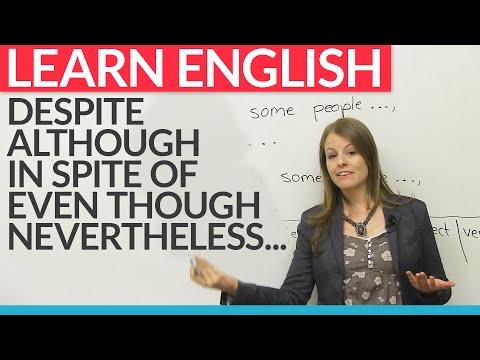
How to express opposing ideas in English: despite, although, nevertheless, in spite of...
0
VoiceTube posted on 2015/07/23Want to sound more sophisticated in your English writing and speaking? This video dives into how to use contrast connectors like 'despite,' 'although,' and 'nevertheless' to express opposing ideas, perfect for boosting your TOEFL or IELTS scores! You'll pick up practical grammar tips and simple sentence structures that make your arguments shine.
Learn this video on the APP!
The VoiceTube App has more in-depth practice for videos!